
3. Take On Me
“Is it life or just to play my worries away? / You’re all the things I’ve got to remember / You’re shying away / I’ll be coming for you anyway.” A-ha
____________________________________________
Cecilia stood in front of the mirror with her green eyes wide open. Conscious of her breath, she inhaled and exhaled slowly, grounding herself the way she did in yoga class..
“Can you press the cappuccino button for me?”
Her voice seemed to vanish in the big house, yet his reply ricocheted back almost instantly. “Oh, like I am not getting ready as well?” His voice made her want to cleanse herself, of his voice and the situation, or him.
“But you are downstairs, right next to the machine. And I’m going to work while you are going to the gym. Please.”
He paused for a few seconds. “I’m not next to the machine anymore. Walking upstairs.”
“Oh, damn, you started walking when I asked you to press the button.”
She passed him in the hallway and he gave her a smirk. Two seconds after that, she pressed the round silver button on the cappuccino machine. In two more minutes, she stepped on the gas pedal. The small, petty war of the morning was over, and the freeway was a clear path to freedom. Life was good again.
Airports held a special place in Cecilia’s heart with the life, hope, happiness, and sadness they brought. Her final destination’s airport was smaller than the one she left behind, but then she thought, what she truly left behind was a big ball of nothing. She smiled at the idea of being away from that colossal void and took a deep breath, observing the impatient crowd at the carousel. The luggage arrived late, giving her time to ponder the lives of couples with excessive baggage. They almost stepped on each other as they grabbed the luggage, yelling at their spouses or kids. She spoke a little Romanian, but their body language was enough. They had a lot of luggage, a lot of words and even more gestures.
The constant yelling reminded her of her own marriage. There was a certain dignity in the lack of yelling. Her friends back home had a marriage on the rocks, but nobody knew. There was no yelling, not in public at least. There is not much happiness, but bickering has to be way more acceptable than yelling. She shook her head left and right, like her old dog used to do, letting go, as she grabbed her luggage. None of the men tried to help her as she struggled to lift the big blue suitcase. She did not think much of it right away, but remembered it later in the cab on the way to the hotel. The cab driver knew only a few English words and she found him to be quite skilled in the way he used them. He helped her with the luggage and then yelled at the bellboy once they arrived at the hotel. She wondered whether yelling was mere communication or simply, the only way they knew how to connect.
“Welcome to the Intercontinental Hotel Bucharest!” The city outside sparkled with lights and contrasts. Old-world buildings stood next to new glass buildings in a kitschy, mesmerizing way.
Checked into her room, she changed while turning on the TV. Despite her modest knowledge of Romanian, the news seemed incomprehensible. Gunshots and tanks? The location of a protest on TV looked like it was the boulevard right down below her. She heard gunshots; she saw tanks and people offering flowers to the soldiers. That was not the image she had of this city.
Cecilia sat down on the bed, petrified to look outside. With the phone in her hand like a magical weapon, she opened the curtains. All she could hear was the city noise. All she could see was the bright light coming from the boulevard, no tanks and no sign of a protest. Confused, she noticed a date, 1989, on the screen. She let out a breath she didn’t know she was holding. Those were images from the Romanian revolution. Her parents had fled before the fall of communism, yet she remembered how they followed those events with the agonizing duality of the exile: their bodies safe in the U.S., while their minds and souls remained stubbornly anchored in the old continent. Relieved, she left the room right away and found herself on the sidewalk.
“It’s midnight on a workday, and people are still out. There must be something about this city that I don’t quite understand,” she texted her girlfriend. She looked around with intense and almost painful joy. The street lights were bright and she welcomed the unexpected, but beautiful light. Downtown, amidst the constant car and wind noise, in a city with 2 million people, feeling trapped in an allegory was a surprising feeling.
Near a subway station, she entered an underground passage, following a group of young people. The light accompanied her, drowning their words. Emerging onto a cobblestone street, she discovered terraces and people. Without consulting reviews or social media, which was so unlike her, it just felt right to sit at one of the tables. Nearby, a tall man and a young woman talked in English.
“Did I mess up your feng shui?”
The girl had a nervous, but loud laugh:
“You’re the one who’s messed up.”
The man put his cigarette down, and got up to leave. The girl looked puzzled and a little embarrassed. She glaced around as if checking who’d witnessed this.
“Sit down, please!”
He grabbed his backpack and started walking away. Cecilia noticed his beautiful, large hands effortlessly moving through the air. The girl ran after him.
“It was a joke, but you should not have embarrassed me in front of my friends, and now this …”
The man stopped to light another cigarette, ignoring the girl, and then resumed walking. The girl kept talking, not yelling, but trying to make a point. Too far away, Cecilia couldn’t hear anymore. The girl came back to the table and paid, only to leave minutes after with tears in her eyes. Cecilia sensed the girl’s pain somehow, enough to lose her appetite. She got up and started walking toward the hotel.
Jet lag took its toll. At a nearby kiosk, they were selling warm pretzels on a string, with salt and a perfect brown color. She bought a few and sat down on the steps in front of the hotel. The pretzels were warm, the air too, with a hint of cigarette smell that did not bother her.
“The entire Romanian nation seems to be raised on those pretzels.”
It was the man from the terrace. He was smoking on a bench next to her, his voice carrying the same sardonic tone from earlier. .
“Oh, are they? I was hoping for sophisticated cuisine. I heard good things.”
He stood up.
“Hey, you’re a fellow American. What kind of good things? As in everything-that-is-good-makes-you-gain-weight-and-maybe-it’s-a-sin kind of thing?”
She smiled. “Are we still talking about Romanian food here?”
“Ha, ha, who knows, this city is hard to understand. It’s friendly and always alive, but it brings up your own hidden drama and mixes it with its own problems.”
“Hidden drama? I assume you are not a therapist.”
“No, I’m not.”
He threw his cigarette into the trash and glanced at her briefly. “Have a good night, OK?”
“Oh, sure, I am jet-lagged, so yeah, sure.” Her mention of jet lag seemed like a subtle invitation for further conversation.
“You’ll get over it. We all do.”
“Are we still talking about jet lag?”
He did not answer and started walking towards the hotel.
Back in the room, she called her friend again. The only link from across the ocean that she wanted to keep while on the trip was a daily call with her girlfriend, Leila.
“I can’t remember the joy. And if I can’t remember the joy, it might as well have never happened. With my history of joyless years, I figured I’d recognize joy when it smacked me. Tonight, I heard a scream inside of me when this guy left in the middle of our conversation, but I stood there and did not move. Many mini-me clones chased him, but I stayed put. Emblematic of my entire life, either I absorb whatever comes, proving over and over that I am strong enough to handle it, or maybe I am as lazy as my mother told me I was.”
“Or you are afraid you are going to be rejected or humiliated in some way.”
“Yeah, that, too, although, how many men rejected me, really?”
Leila laughed. “None that I remember, girl.”
“Wait, you know what, how about I call you from the lobby so you can see this place versus my room?”
She quickly threw on flats and a skirt, taking cues from the city’s vibe. Holding up her phone, she showed her girlfriend around. “This place is like no other city I have been to; it screams home somehow and I have not even left downtown yet.”
“Your roots are calling, I guess,” Leila commented.
“Yes, and I will meet a cousin tomorrow. I want to hear about my family, of course, but I want to discover the city on my own as well. I will send pics later.”
She was standing in front of the hotel with the phone still in her hand when a car honked.
“Hey, your cab is here.” She turned around and there he was.
“I did not order one, because I don’t get in cars with strangers,” she replied, trying to be both funny and sarcastic. However, the moment she uttered those words, her entire body quivered with the fear that he might be put off by her comment.
“Fair, I guess, and I am just parking my car anyway. I had to move it.” He got out of the car and the valet grabbed the keys. He held only a water bottle, in time for her to think how American that was. People did not drink a lot of water in Europe. She felt she had to say something or the conversation could have ended abruptly again.
“It must be crazy driving a car in this city.”
“Crazy, crazy, many things or people don’t deserve that label. I would say more like uncomfortable at times, but doable.”
He looked very tall as he was standing there with his water bottle. She definitely wasn’t empowered by what he was saying, but she liked that he was listening. Rather than diminishing her, the imaginary slapping sensation she felt every time he replied served as a peculiar awakening.
“I’m going to drop off some stuff in my room and what do you think, do you want to take a walk after?”
She nodded. “We could do that.” He disappeared inside the hotel with oddly deliberate and unhurried steps, almost as if he were awaiting a red carpet.
She lingered outside the hotel and eventually found herself in a wingback chair inside. People watching was entertaining, but waiting wasn’t her favorite game. It was dark and the city had an almost serene feel, with shimmering lights and people moving like pawns on a chessboard. Then it hit her: he wasn’t going to come. She started walking away, occasionally glancing back. Her map application was a good guide, but she could have done more research before the trip. Her decision to travel was more spontaneous than she thought she was capable of and now she was not prepared. The more she walked, the more she could hear her steps on the cobblestone streets becoming the loneliest steps in the world. A message from her cousin convinced her to return to the hotel, rest, and prepare for another day of discovery.
The following morning, coffee in hand, she waited in the lobby for Carmen, whose bright blue eyes reflected an infectious enthusiasm for the world around her. Carmen insisted on introducing Cecilia to a restaurant she swore would enchant any visitor. “Oh, you will love it. All foreigners do.” And Cecilia did. The Neo-Gothic architecture of Bucharest’s oldest brewery building was captivating, but she loved more her cousin’s coming-of-age stories about her life in the ‘80s in Bucharest, a city, which to Cecilia, still seemed stuck in the ’80s with its familiar nostalgia.
“I’m meeting some of my high school friends for lunch if you want to join us. I know we ate, but I had this scheduled already and it would be good to meet some locals.”
Cecilia realized she hadn’t really met any locals other than the hotel staff and the driver who brought her from the airport. She briefly thought about her American man from the hotel with his Romanian girlfriend and Johnny Depp-like attitude. She had heard that Johnny Depp was actually spending time in Romania. With that random thought, her other jet-lagged thoughts became overpowering and suddenly that old migraine resurfaced. Luckily, they walked outside.
The boulevard felt so familiar to her somehow that she wanted to take everything in, put her wings on and soar above the cars and buildings. She felt she had been there before and came back only to revisit and make new memories. They passed another Neo-Gothic building surrounded by a big park. “It’s the Cretulescu Palace. They built the Cismigiu park around it in the 1900s. It’s a happy place for many. We will meet my friends here near the lake.”
Grateful for the impromptu tour, Cecilia forgot about her migraine and looked around to absorb every detail.
“They say that Hotel Cismigiu, the one to the right, is haunted by a student who fell into the elevator room and died there. Americans like ghost stories, don’t they? There are plenty here, but I don’t think we market them very well.”
Cecilia smiled. “Oh, there is a market for that kind of stuff for sure. Talking about the paranormal, I have a feeling I have been here before.”
Carmen stopped: “But you did. When you were little, we visited this park.”
Cecilia let go a surprised sound. “I don’t know, I thought my mom never went back and I had no pictures to prove otherwise. I was starting from scratch but then the more I walked around, the more it felt familiar. How old was I?”
“Oh, we were both in elementary school. I just remember playing here at the playground. My high school memories take over after that. But I still remember our time together.”
They continued walking. The park had a vibe of old and new together that she actually liked. The old statues and benches contrasted with the playful sounds of the kids playing. Then there was… Monte Carlo Restaurant.
“Here is the restaurant where we will meet my friends,” stated Carmen, while she checked her phone. “We are way too early, but I have to make a work call quickly. Do you want to sit down and wait here?”
Cecilia looked around. Although early in the evening, the restaurant was full. She felt that the park did not tell her a complete story though and she needed more. “How about I walk around more?” I can just get back here in maybe 30 minutes or more.
“Sure, just ask for the Monte Carlo restaurant if you get lost.”
Cecilia started walking down the path and felt free and happy like the park was her own backyard. The fallen leaves crunched beneath her feet as she wandered along the paths, with beautiful statues and beautiful people, not really knowing where she was going, but not afraid to find out.
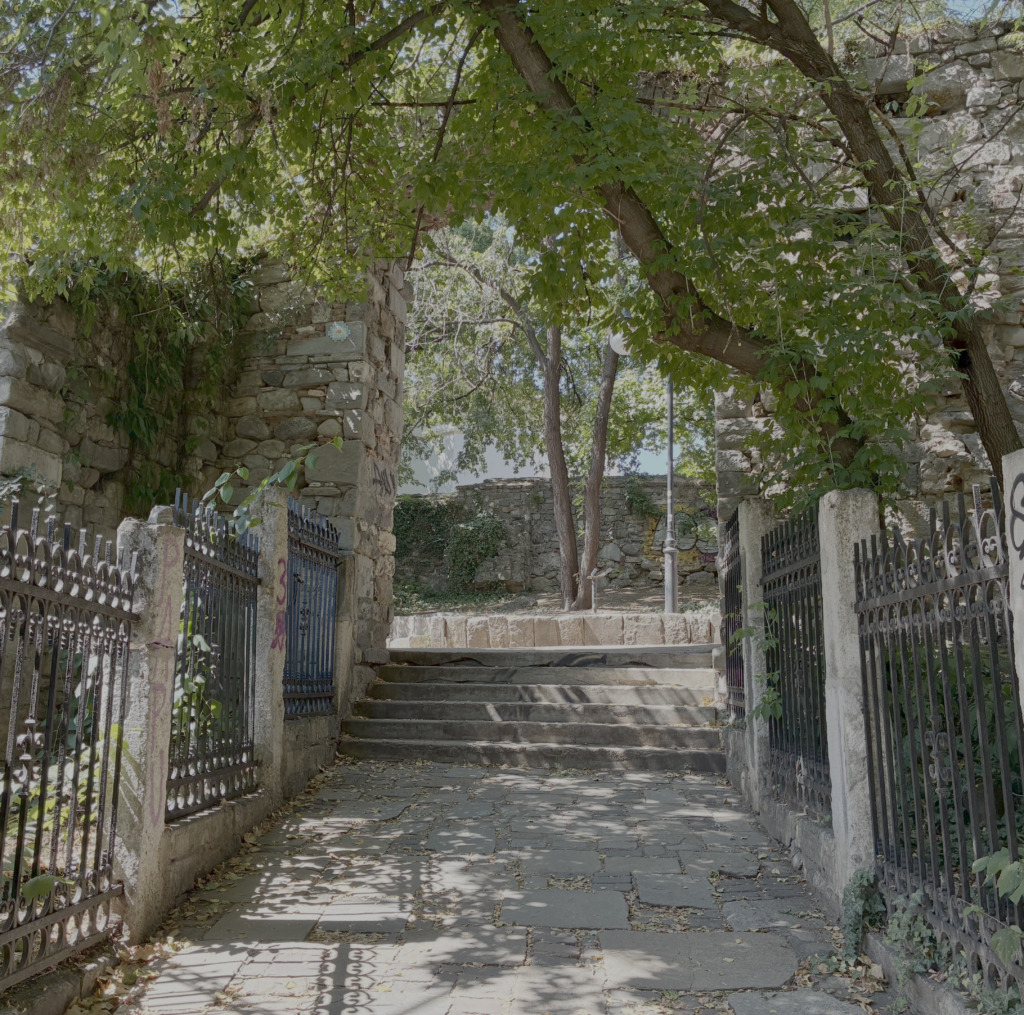
At the end of one path, she saw a stone archway opening to a sunny area, which took her to a courtyard that looked like the world’s perfect ruins. She ran her fingers along the weathered stone, imagining the walls that once stood centuries ago. That’s when her foot caught on an uneven paver, and her ankle twisted painfully. She gasped as she lost her balance, tumbling forward. Time seemed to slow as her head struck the hard path before everything went black only for the darkness to fade into a bright light shortly after. “Just my luck, to hit my head on this trip,” she exclaimed as she tried to get up. “Are you alright?” a boy in a school uniform asked. “I saw you fall. Here, let me help you up.”
Cecilia’s head spun as the boy reached and grabbed her hand. Something wasn’t right – his outdated uniform, and the shift in atmosphere in that park. “I’m supposed to go back to the Monte Carlo restaurant.”
The boy laughed. “I would like that too, but we are high school students. They don’t like us hanging out there. Well, we still do though.”
She blinked a few times before locking eyes with him.. He continued, “Actually, they would not like me hanging out with a foreigner either, which I assume you are by your clothes, but you probably know that. 1989 in Romania is years behind Western Europe or America, so I apologize for that.”
1989? Was it before the fall of the Berlin wall? Before the revolution in Romania? It sounded that way since the kid mentioned that they were not allowed to mingle with foreigners. That restriction was specific to the communist regime and she already knew that.
Cecilia’s eyes widened as the realization sank in. She had somehow traveled back decades into the past to communist Romania. This seemed impossible. The boy’s uniform, the weight of the air, and the park felt undeniably real. Since the words have left her, she nodded to show she understood what it meant to have relationships with foreigners under the communist regime.
“Where are you visiting from?”
Cecilia hesitated, wondering how much to reveal. “I’m from the U.S. I guess so, I don’t really know what is going on…”
“You look like you could use some help. I’m Andy.”
“Thank you, Andy. I’m Cecilia. And you may be my only hope of making sense of…whatever this is. Am I bleeding? Is my head bleeding?”
Andy glanced at her head, then got closer and started examining it. She could feel him breathe and if she had doubts about what was going on or thought it was a dream, this was the time when it felt more real than she wanted to admit. He declared with a smile, “No blood. How are you feeling?”
Cecilia touched her head. “I feel great actually. No blood on my head and I don’t see any scrapes on my knees or anywhere else. That is strange.”
What was stranger though was the year she was reliving now. 1989? Cecilia’s mind reeled. As she stared at the surroundings, she couldn’t shake the feeling that she had stumbled into a living remnant of Bucharest’s past, a time warp to the city’s communist era.
“I really appreciate you helping me out, Andy. Is there a bathroom here where I can find a mirror to assess the damage a bit closer?”
“You’re not bleeding, as I said. But there is no mirror close by. Maybe we can go to Monte Carlo and you can check there in the bathroom.”
Cecilia perked up at the mention of Monte Carlo. “Monte Carlo, yes, that is where my cousin is waiting for me.”
They started walking. The alley looked the same as before but the people looked different. There were teens in uniforms cheerfully walking and talking, well-dressed elderly couples and young women with big, teased hairdos and those iconic flat shoes. She felt like she stepped into a time capsule, a kaleidoscope of youthful energy, and timeless European elegance.
“Are you hungry?” Andy asked.
“I could eat, but I need to make sense of everything and find a mirror first. My head does not hurt at all, but the mirror is still very much needed.”
Here it was, Monte Carlo. The restaurant stood there the same way she had left it 30 minutes ago. There was no Carmen and the layout was slightly different.
A short, skinny boy came running and Andy turned to Cecilia. “This is my friend, Paul.” The waiter whispered something to the boys and they laughed. Paul explained, “Every time we come here he asks us if we should be in school. He is playfully asking. They are happy that we come here to spend money. They even let us smoke.”
Cecilia smiled and nodded her head as he talked. He was kind and chatty, but she really needed a mirror. She ran to the bathroom and as the door opened, she saw in the mirror the 1989 Cecilia staring right back at her. A wave of emotion came over her and she touched her face laughing hysterically. “Oh, I will make the best out of whatever this is. As long as I am not dead, and I don’t think I am, I want to live like it’s 1989!” She ran out of the bathroom, ready to embrace what was coming her way. Andy and Paul stared at her as she made her way to the table. Being a teen again felt as good as it did the first time.
Paul offered her a cigarette.
“You know, these are bad for you, like really bad,” she said. “I would rather have a ciorba.”
Paul laughed while Andy smiled and lit his cigarette. “I know, I know, but I am not aiming for a long life, just a good one filled with love and adventures,” he said.
She almost wanted to explain how he didn’t truly understand the harm, and how years from now, people would realize how harmful cigarettes were, but she held back and just asked:
“Wouldn’t it be better to have love, adventures, and a long life?”
Paul chuckled and nudged Andy. “You’re inspired today. Go ahead and write that letter.” He added, “Andy writes love letters for a girl, you know, on behalf of the girl, who is trying to impress her long-distance crush.”
Cecilia leaned in, intrigued. “Love letters as a service? That’s fascinating.”
Andy nodded. “Easy money. She used to pay per letter, but now I charge upfront for a few, a win-win.”
Paul lit his cigarette. “The master at work!”
“The writing is entertaining, but her transformation is the best part even though she is not the author. She becomes the girl who would write those words, if she could. I look at it this way, she becomes a different person thanks to my words.” Andy stubbed out his cigarette and began writing.
Paul laughed. “If she could, that is? She couldn’t man, she couldn’t write any of that, but they got to her. She even dresses differently because of the letters.”
Andy looked at Paul as if he wanted to tell him to stop. “We are who we tell people we are, right? That is the way we want to be seen, so we become that. Even fake writing creates that illusion.”
Cecilia smiled. “I would not call it fake writing. It’s your writing and it’s as real as it gets. She becomes real by inhabiting your words, even if she did not actually write them.”
“There you go, you know what I mean. She becomes my writing. But thanks for indirectly calling me real. I try to keep it real.”
Cecilia was so entertained, she forgot the big bowl of ciorba, the sour Romanian soup, in front of her.
“I’ll finish before you finish your ciorba,” Andy smiled. “Plus, ciorba inspires me. Let me see how you sip it.”
Cecilia grabbed her spoon. “How is this relevant?”
Paul laughed again. “It’s not. He’s messing with you.”
“Oh, but it is. She sips the soul of Romania in that bowl, a mishmash of ingredients and stories. It must be witnessed.”
“I’ve had soup before, you know.”
“Not with me watching,” Andy winked.
Cecilia would have blushed if she could; being 16 again with these boys writing innocent love letters for money was the most fun she has had in years. She sipped slowly and quietly, noticing Andy writing as she lifted her head.
“I’m watching, I’m watching, just don’t lick the spoon. My mom always gives me dirty looks if I do that,” Andy added.
“It’s definitely all about looks here in Bucharest. And I mean by that, not only how you look, but also how you behave and you are judged by your grades and manners, in our school at least,” Paul commented.
Cecilia took one more sip of the soup and put the spoon down. “So your school, do they allow visitors? I would love to see it.”
Andy looked at Paul: “Maybe after hours. They allow visitors, but not foreigners. You’re in communist Romania, 1989, why do we have to remind you?”
Andy looked toward the door, where a tall blonde approached.
“Dummies, you could have waited for me.”
Paul explained to Cecilia, “She’s calling us names for not waiting while she got stuck in that useless class. Simona, this is Cecilia, a visitor, not sure for how long.”
Simona had big dark eyes and was wearing pink lipstick. She turned to Andy:
“Is that a new letter?”
Andy folded the paper and put it in his pocket.
“Wait, don’t we get to hear it?” Cecilia asked.
“It’s confidential! A serious business!” Paul exclaimed.
Cecilia realized that she felt like an outsider until a familiar voice called from behind: “I waited in front of the restaurant. What are you doing here?” It was Carmen, her cousin, in uniform and with the same pink lips as Simona’s. Suddenly, Cecilia felt she belonged.
Her cousin pulled her aside. “You are going to get these kids in trouble.” Cecilia didn’t quite understand. Luckily, Carmen continued.
“They are not allowed to talk to foreigners. I am not either, but we are relatives so my family is already being watched. Just exchange phone numbers. Well, just tell them to call my house. Let’s go!”
Cecilia turned around, “Hey, boys, maybe we will talk again.”
Paul waved and Andy got up. He came toward her and she felt how the closer he got, the more she wanted to grab his hand and walk around, talking for hours. This was what those kids did anyway, but not with her. “Carmen, bring her to the party tomorrow.”
Carmen sighed, “I was going to anyway, you don’t have to tell me, just don’t think you will mess her up like you know who.”
Andy stepped back, “And, once again, I am not sure if you are mean or negative, two very different things, and I am also not sure which one is worse. But we’re Romanian. We insult people to their faces, so don’t let me stop you. Bye, Cecilia.”
He walked back to the table, his enormous feet moving in an awkward, duck-like waddle with a cigarette dangling between his fingers, and in that moment, Cecilia knew without a doubt that she was going to that party.
The parties during those times were frequent, with the same circle of kids gathering at each other’s homes nearly every weekend to dance and hang out. Slow dancing was a central ritual at these gatherings. Boys always invited the girls, so if the host was a girl, she meticulously curated the guest list to ensure an equal number of boys and girls.
Uninvited guests often tagged along with others.. Take Bobby and Tavi who were on most parents’ “blacklist,” but always they found ways to get in. Their offenses weren’t serious, usually raiding the fridge or accidentally breaking something in the house. The evening of this party, Bobby arrived with his girlfriend, trying hard to stay on his best behavior. Tavi showed up too, carrying a stack of mixed tapes with handwritten song titles on their cases. These counterfeit tapes, filled with ‘80s hits smuggled into Romania, provided the soundtrack for every party, as kids danced, smoked cigarettes, and sipped homemade sour cherry liquor.
They knocked at the apartment door where the music was blasting from, and the girl whose party that was answered.
“Guys, my mom told me specifically to not let the two of you in,” she said firmly.
Bobby quickly pointed to his girlfriend standing next to him, “But I brought her! She’s going to make sure we’re good tonight.”
Tavi chimed in with a grin, holding up his stack of cassettes like a peace offering. After a few more reassurances, she finally relented and let them inside.
Once in, Bobby tried hard to stay on his best behavior while Tavi headed straight for the cassette player. In the end, they were all good kids, juggling their almost-perfect academics with some wannabe-naughty behavior outside of school.
On the way to the party, Carmen gave Cecilia a quick rundown. “I don’t want my parents getting into trouble. We already have neighbors asking if we’re hiding foreigners. A few kids know who you are, but don’t draw attention to it. You wear the right jeans and smell like a foreigner. Even the ones who don’t know your parents emigrated will figure it out even before you say something.”
Cecilia nodded. “What about Andy?”
Carmen stopped walking and grabbed her hands. “Listen, he’s not well-liked. I wouldn’t call him a player, but he doesn’t treat women right. Nothing major or super bad, but he changes his behavior unpredictably. Sure, he reads a lot, and that makes for great conversations, but don’t get attached. Honestly, don’t even have a fling with him, but, go ahead and enjoy the intellectual stuff.”
Cecilia sighed. “I like him. He looks like Jean Marais.”
When they got closer to the apartment building where the party was, two boys were sitting on a bench right in front smoking cigarettes. “Hey, beauties, are you going to the party upstairs?”
Cecilia felt amused and smiled but Carmen interrupted those flirty ways. “Shut up, you’re wasting your time and definitely wasted mine already.”
One of them suddenly got more interested than he initially was. “Hey, blondie, why are you upset?”
Without answering, Carmen opened the building door, leaving the boys out. Cecilia looked back. “Boys are aggressively pursuing girls here, aren’t they?”
“It’s a toxic macho culture. They are harmless mostly though if you don’t respond, so I usually don’t, but you are with me and I did not like them approaching us.”
The party was just beginning when they arrived. A few kids were in the living room chatting, while the other two rooms each had their own crowd. One was always loud with hard rock fans blasting their tunes in a room full of smoke while the other room filled with teenagers navigating the drama of first loves, breakups, and whispered secrets. It was a small, intense world, a pocket of youthful escape framed by the realities outside.
She hoped to see Andy, but he wasn’t around. So Cecilia struck up a conversation with Bobby and Tavi, who were hanging out, ready to stir some trouble. “I have a neighbor in Canada,” Tavi said. “He brings me one vinyl every summer. I get to tell him what I want. We meet at the park and play basketball so I don’t cause any trouble for my parents.” Bobby interrupted with a grin, “Let’s raid the fridge.” Tavi chuckled and tried to push him away while his eyes remained locked on Cecilia. She found them amusing, especially their vests over shirts, very clean-cut and reminiscent of Depeche Mode’s slick ‘80s style.
The door swung open and Andy came in, loud and confident. He greeted everyone, but skipped over her. Carmen leaned in and whispered, “What did I tell you? Now he’s pretending he barely knows you.” Cecilia wasn’t sure if it was a game or reality. Taking a deep breath, she tapped him on the shoulder. “Hey, how are things?”
“Things are good.” He turned his back, heading toward the tall, athletic girl in the corner and pulled her to dance.
Andy’s presence was magnetic, part bravado and part youthful rebellion shaped by the Romanian conjuncture in the ’80s. In these small party rooms, the music wasn’t just background; it was an act of defiance. Dancing offered a brief escape, and those Western music mixed tapes, which were passed, copied, and traded until every kid had them, made the free world feel just a little closer. Cecilia quietly slipped out and headed for the room she secretly preferred: the hard rock room.
The raw energy of that space was what she needed. The quiet boys with long hair smoking and listening to hard rock were almost relaxing at that point. She wanted to hide and that was the place to do it for a few moments. Nobody bothered her and it was so dark that she did not even think they noticed her. So she wandered into the kitchen; there, she found Andy leaning against the window sill with a cigarette dangling from his fingers. The harsh glow of a single bulb cast long shadows on his face as the smoke curled upward, dissolving into the dim light. For a moment, the loud bravado was gone, replaced by something raw and she felt more attracted than ever to him. “You’re hiding here,” she said quickly, afraid she was not going to come up with anything at all.
“I needed to breathe.”
“You breathe in cigarette smoke,”she added and smiled. Then she freaked out that he was going to walk away after that comment, so she added: “But I get it, the music and the crowd are overwhelming and so intense.”
“These parties,” he gestured toward the living room, “are so magical to us. Are you even having fun the same way? Maybe you have more places to go out with music and dancing. We have our own apartments and, on nights like this, they become whatever we want them to become. I’ll never leave this country. Or I don’t think I would. No matter how tempting the outside world seems.”
She raised an eyebrow, surprised that the conversation went that way so quickly and did not know if he wanted to offend her. “Why? Most people dream of leaving, finding a way out.”
He shrugged and looked at her..“I’m tied to it: the past, the expectations, and the weight of it all. It’s like wearing a second skin. You shed it and find nothing underneath.”
It was Cecilia’s turn to really look at him. Beyond the bravado and restless energy, there was something fragile beneath, an unspoken storm he carried alone. His brown eyes were so brown and deep that she was almost afraid of what was hiding behind them.
“You sound like you read a lot,” she replied instead. “You always surprise me with what you say and how you say it.”
“Books are safer than people,” he said bitterly. “Out there, emotions are messy. But in books, everything makes sense. History, philosophy, chaos, and even madness. It’s all there the way we want it to be.”
He flicked ash into the sink and looked at her with a mix of defiance and vulnerability. “Sometimes, I wonder if I’m the one who’s mad, not the world.”
This was no ordinary boy, she thought. This was a mind wrestling with itself, searching for meaning in a prison disguised as a home. She just wanted to hug him and kiss him, but she didn’t want to be pushed away. But that didn’t stop from wanting the hug.
“Tell me,” he asked. “How is your life in America?”
Cecilia stood on the wobbly kitchen chair. “It’s different. People are different. They don’t seem so judgy and negative. Maybe because they’re happier.”
“Are they though? How do you define happiness?” he countered.
She hesitated. “Let me step back. In this circle you guys are in, forget about what’s happening outside, you and some of the kids in your school live in a drama of intellectuals who don’t know how to function in a society of mediocre individuals. So you hate that society.”
“Why would we? Why would we?” he asked in an almost playful way, while getting another cigarette.
“Because that’s the reality. I hear people say Americans are stupid, but are they? What do you gain from holding onto that idea? From judging others based on what you don’t understand? You got the smarts, but you want to use the smarts and the knowledge to get you out of there, don’t most people want that? We are already there.”
He inhaled deeply, smoke curling from his lips like a veil. “Maybe it’s about survival here. We grow up mistrusting everything and everyone. I never thought of it that way, but maybe it’s a defense against disappointment and betrayal. Happiness isn’t about smiling or laughing out loud. It’s something quieter, more complex.”
“In America, happiness is treated as a right, or a goal you’re supposed to reach. Here, it’s more like a luxury few can afford. Is that it?”
“Some people in the villages find happiness. Many of us have grandparents in the countryside, and we’re sent there every summer. It’s a kind of raw, primal freedom you can’t get in the city, even among the poor. Maybe because that’s all they know and they think it’s enough. Also not reading means not questioning as much and trust me, you don’t want to question anything in this country,” Andy said. “I agree that here in Bucharest, we are intense, skeptical, or yeah, you can call us judgmental. But there is passion in that intensity, of course combined with sadness or with rebellion at our age, I guess.”
She caught him looking at her with those deep eyes, so she answered quickly. “From the outside, that intensity looks like the opposite of happiness if you ask me since I have seen both sides.”
“Lucky you for sure that you had the opportunity to see both sides. Maybe it is the opposite of happiness,” he said sarcastically, “but it’s the only skin we’ve got.”
“Or allowed to have,” she added.
There was a long silence between them covered by the soft glow of the single bulb and the quiet rhythm of his cigarette smoke rising. For a moment, their different worlds seemed to touch. She wanted so badly to reach out and grab his hands, large and beautiful, yet surprisingly untouched by his smoking habit.
Carmen came to the kitchen with another girl chatting. “Oh, my god, Bobby is making out with a girl on top of the coat pile in the other room, I guess, and his girlfriend is looking for him because her father is coming to pick her up. Tavi finally went to tell him. We tried to keep the girlfriend busy and every single boy took turns, inviting her to dance.”
Cecilia suddenly felt anxious and remembered they promised her aunt they would be back before midnight. “I think we should go, too. I want to catch the metro before it gets too late.”
Carmen laughed. “I will call her and tell her nobody is leaving before the morning. The parents are just across the hall at their neighbor’s and will spend the night there, so we can stay.”
Cecilia hesitated for only a moment before nodding. “OK, but if you think it’s OK.”
Carmen went to call her mom. “Do you want to dance?” asked Andy. He grabbed her hand and took her to the dance floor. There were only two other couples, moving slowly. The song was so much shorter than she had expected. At the end, this girl with short hair and big glasses came to Andy. She whispered something and he smiled. “Tonight?” She said again something and handed him some paper and a pen. He sighed and headed toward the kitchen. Cecilia stood in the middle of the room not knowing what to do. Following him could have seemed a bit clingy so she went to Carmen. “Who is this girl?”
“Oh, that is not competition for you. This is the girl who pays Andy to write anonymous letters to this boy from another class she likes. She feels her writing is too personal and he will figure it out. She types it on the typewriter, but Andy composes them.”
Oh, she wanted so much to see the whole process. So she used the old bathroom excuse since going to the bathroom meant passing by the kitchen. When she passed though, his head was down and he kept writing. On her way back, she stopped by the door. “What is that,” she asked simply because anything else would have seemed too prepared.
“It’s part 2 of what I was doing at the restaurant. Are you a good writer?”
“I think so. Do you want to write it together? I don’t even want half the money.”
Andy smiled. “Good. Read this and tell me if you have any suggestions. You have to tell me the truth.” He handed her the paper, and she could feel the warmth of it, still carrying the imprint of his hand.
“I don’t have the context of the other letters.”
“This is only the third one. Just read it,” he snapped.
While almost surprised by his tone, she obliged.
“It’s fine, I don’t want to change anything.” She gave him the paper back quickly hoping he would see that the tone upset her and she was indeed waiting for an apology. He did not.
“So little miss does not want to play. Or maybe she only wants to play by her own rules.”
Cecilia did not understand what was going on. “Andy, this is not fun anymore.”
“Why do you always expect fun?”
“I don’t expect it, but I want it to be fun. Why so intense?”
He looked her in the eyes. His eyes were so much more intense than his words and she just melted.
“Do you know how I got the idea to write these letters? There was this girl who wrote me anonymous letters for a while, and she got the idea from one of the books she read, Lorelei! Did you read that book? Probably not; it’s by a Romanian writer. Wait here!
He ran to the living room and in two minutes, he came back with a book.
“Sit down!” She felt again that he was being somehow aggressive and did not like it, but sat down. He started reading, pausing a bit as he was translating.
“Everything separates us, you and me: distance, people, and maybe even destiny. Do you remember? To meet Caesar, Cleopatra, accompanied by just a single loyal follower, crossed the sea by boat, braving it, and let herself be wrapped in an ordinary sack and carried into Caesar’s palace, without anyone suspecting that inside the bundle carried on their shoulders, the Queen of Egypt was coming to see Caesar. Look what my letter brings you. I am not even afraid of your smile. So, I am afraid of anything. I am what is beyond your window: distance. I am the saddest girl in the world among her swallows, because I wrap myself entirely in the unknown. Your gaze will never find me. Your memory can never discover me. Your voice can not call out to me and does not know where. longer call out to me. I am scattered to the four corners of the earth: their crossroad.”
He paused. “The girl who wrote to me told me she initially wanted to write this, because it is the world’s best anonymous love letter. But she was more creative than that, so she wrote her own. It worked for us. It brought us together. I don’t have the girl anymore, but if I can bring other people together, why not?”
Cecilia did not know what to say. He suddenly seemed sad and helpless. She got up to leave, but he came and grabbed her head, pushing her gently into the wall. He kissed her quickly, a kiss that felt more like a goodbye than the beginning she was hoping for that night. Carmen came in just as he let go of her head and sat back on his chair. The air felt so heavy that Cecilia felt like she couldn’t breathe. She ran out and she heard Carmen ask playfully, “What did you do to my girl?”
They left soon after and Cecilia told her the entire story. “Who is that girl that Andy is talking about? Is he still in love with her?”
Carmen sighed. “Oh, the drama! That is Mona. They were both proud and dramatic. It wasn’t really a circus, more like a play you were watching non stop with those two. I think it finally ended, but you never know…”
Cecilia felt a bit of that retroactive jealousy that all women feel, but then she remembered that this was the 1980s all over again and it was way more dramatic than the first time around.
“Why did he kiss me? Must mean something.”
“To you maybe.” Carmen stopped and grabbed her shoulders.
“That kid is just weird. And he is known as Mona’s boyfriend forever and ever in this high school. Let him be that.”
Cecilia needed more. She needed more of him or she needed closure. That night, she fell asleep thinking of that kiss. It felt as real as the 1980s the second time around. She wanted more of that kiss and more of this world.
The next day she stopped by the school to “visit” Carmen. She looked everywhere for Andy, but he wasn’t there. When class started, she hung out in the backyard, hoping again he would show up. He did not so she left. A woman was selling pumpkin seeds outside of the school while a girl in front of her was frantically searching for the white headband in her pocket. She put it on her head a little crooked and hid the pumpkin seeds in the other pocket. The woman sat on the sidewalk spitting out the seeds shells with an “I don’t care about anything” attitude.
“Yeah,” Cecilia thought. “Let’s spit out one more man out of my life.” She smiled and started walking toward the cathedral next to her school. She felt the need to go inside but her gaze somehow turned the opposite direction and her heart fluttered. In the bus station, smoking, Andy was leaning against a wall staring at the boulevard in front of him. Her first reaction was to hide, what better place than a church, but the moment she stepped inside, she turned back and crossed the street.
“Andy!” Her hands got suddenly cold and her tongue felt very heavy.
“Oh, Cecilia, my new friend.” His brown eyes looked through her, almost empty of any expression. He got close to her and she almost felt he was going to lean in for a kiss. His arm was bent as he was getting ready to touch her softly. He did not.
“Are you coming or going? I am not sure what you would do at this time.”
“Oh, the eternal question. If we pay no attention to it, time does not exist.”
Her first reaction was to make a joke, “Oh, so intense again.” But she felt it bothered him the other night, so she did not. Luckily, he continued.
“You probably did not read Mircea Eliade.”
She shrugged her shoulders. “I did not.”
“You should, you should. Come!”
He continued to hold the cigarette with his right hand and grabbed her hand with the left.
They started walking on the wide boulevard. Her cold hands did not get any warmer, but her steps matched his, jerky and hesitant, heading into the unknown.
The park was unfolding before them, leaving the city behind, almost as a magical gate to another universe opened. They went in through the gate from the cetate, that fortress where they first met. He let go of her hand and walked in front of her quickly, his big steps feeling suddenly as cold as her hands. He lay on the bench with his eyes circling the birds in the sky and she stood there uneasy, waiting for something to happen.
“When you want something so much, so much, that desire brings with it the fear, as strong as the desire, that the thing won’t last, and that kills the pleasure and makes it uncertain like a candle in the wind.” He paused. “And I love Candle in the Wind by Elton John!” He laughed hard and looked at her briefly.
“Are you afraid of beginning or of endings?”
“I am not afraid of anything. But the worst of all is being afraid of things because they might not begin.”
Her head was spinning. Was he talking about them? She did not ask but he answered almost like he knew.
“I knew this girl, I know this girl actually, who used to say that everything that was straight seemed inaccessible. So she always took lots of turns and came up with lots of solutions to problems that were not even problems. But that was her journey. You can’t live believing that everything you do somebody else can do better, that your thoughts don’t belong to you, but to someone else as well and that your ideas are just the result of years of conversations that others had way before you. You can’t pour your soul in a long letter, give it to somebody and then tell the person to tear the paper into small pieces and do a physics experiment on charging by friction.”
She wanted to ask about the girl, but, instead, she smiled. “Everything comes down to math and physics in your group.”
He smiled as well. “Good observation. I guess so. One of our math teachers told us he did not care about the students’ education, because math is educating them on its own.”
She wanted to tell him that there is so much more, that she traveled back in time to live her teen years all over and this round felt more alive than the first. But the words stayed caught in her throat, heavy with everything unspoken and probably everything too late.
He pulled a cigarette out of his pocket and they started walking again. “Listen. I wish I wrote this, but I didn’t. That girl I mentioned used to spend hours writing down in little notebooks quotes from the books she read, like Lorelei, which I read to you earlier. This is from one of the anonymous letters the protagonist was sending to her husband. ‘Ten years ago I would have said peek-a-boo to you. But my soul has lost the voice of childhood. Can you hear it? Do you hear the wind at the window? Do you hear the birds that leave and return, carrying and bringing spring? Do you know what nostalgia is? Sometimes I look out the window without seeing anything. I am both there and nowhere, without form, both near and distant from you. Think of me as a star torn from you and carried into eternal shadow.’ So what do you think?” He paused and looked at her with his big eyes. “Cecilia, do you hear me?”
She heard his words, but as she took another step, her body surrendered to gravity, limbs tangled, and her breath caught in her throat. The stairs rushed up to meet her and she felt the world spinning in a blur of light and shadow.
She opened her eyes to Carmen’s worried face, kneeling beside her in the park. “You hit your head! I’ve been looking everywhere! Did you break anything?”
Cecilia sat up slowly, touching her temples. The memory was already becoming dreamlike, slipping away like water through her fingers. Many thoughts rushed through her head, and she started thinking all of them at once: how some boys learned young that pushing people away was safer than holding them close, that fear could masquerade as intensity, and that running could look like passion from the outside.
She smiled as she thought that she almost fell in love with a ghost version of a boy who probably grew into a troubled man. And somehow, that made her think of her own failing marriage. She’d married the safety Andy could never be, but safety without passion was its own kind of prison.
“I’m OK!” She looked at Carmen and took a deep breath. “And I am not broken, just returned.”