
2. Pure and Simple
“Love is the truth, I realize / Not a stream of pretty lies / To use us up / And waste our time.” The Lightning Seeds
_________________________________________
Across the dining room table, she clutched her phone while he flipped through a stack of old photographs, each of them pretending not to notice the other. He felt their conversation, or lack thereof, had become a ritual.
“Look at this one. I was only five when it was taken and I remember that day perfectly.”
Andy slid one of the photographs across the table towards Clara. She studied it, raising only one brow.
“Why did they dress you like an orphan and cut your hair so short?”
He looked again at the photograph. “I don’t really remember caring about the clothes, but I definitely recall how much I hated having my picture taken. And what do you even mean by dressing me like an orphan?”
“They went for pitiful, but not messy.” Clara let out a soft, knowing sigh and started scrolling through her phone again. Then she suddenly looked up, seeking his eyes across the table: “Let me put it in a different way: styled for sympathy, not chaos.” She laughed, the tension in her shoulders finally easing. He waited, his face giving nothing away. She could have left it there, but she did not.
“So the aversion to participating and following the simplest societal rules started early, huh? Figures.” She looked down at her phone again and for a second, he wished he had a button to press and freeze her in place. But he just shrugged, glancing down at the photo again.
“I like this journey through old photos. But you couldn’t join me, could you? I’m more like a screen for you to project your dreams rather than your McDreamy.”
Sometimes, his eyes held a sadness that left her uneasy. This time though, Clara burst into laughter again. She knew that this conversation about his photos would eventually taper off and take its place in the tapestry of unfinished conversations they always seemed to have.
“McDreamy? That’s more my kind of line.” A mocking tone crept into her voice. “What’s got you so irritated this time?”
“You don’t see it?” Part of him wanted to storm out, slamming the door behind him. But something held him back, an inexplicable sense that he owed her something, and he’d never been one to leave debts unsettled.
Clara’s voice softened, surprising even herself as she looked him in the eyes. “I see it, but I don’t know why I do it and I don’t know what we are doing here anyway.”
She tilted her head back in an unforced motion that exposed her long neck and the scar she usually hid with her hair. For a moment, Andy felt both closer to her and further away than ever. He wasn’t sure if she wanted to hurt him, or if the quick, cruel reactions were just self-protective arrows shot just in case she got hurt. Clara knew exactly when she upset him, but she didn’t always understand why. “It will pass,” she thought, turning away. The silence stretching between them became almost suffocating, yet neither seemed willing to break it. Clara’s laughter had faded with her mind wandering elsewhere.
Andy stared at the ground. “You know, I’m going to grab some wine. Unless we’re not going to Bianca’s tonight?” He felt his words leaving his mouth without a trace of annoyance, as he consciously tucked her words into that familiar corner of his soul where her insults had accumulated over the years. She answered with a dismissive wave. “Of course, we’ll do whatever you want.”
Andy left without slamming the door, though the temptation lingered. “You can slam the door, break a plate, punch a wall,” he’d once told Clara, “but the pain still remains.” He wanted to shed the pain yet keep the nervous tension, to draw strength and inspiration for his writing from it.
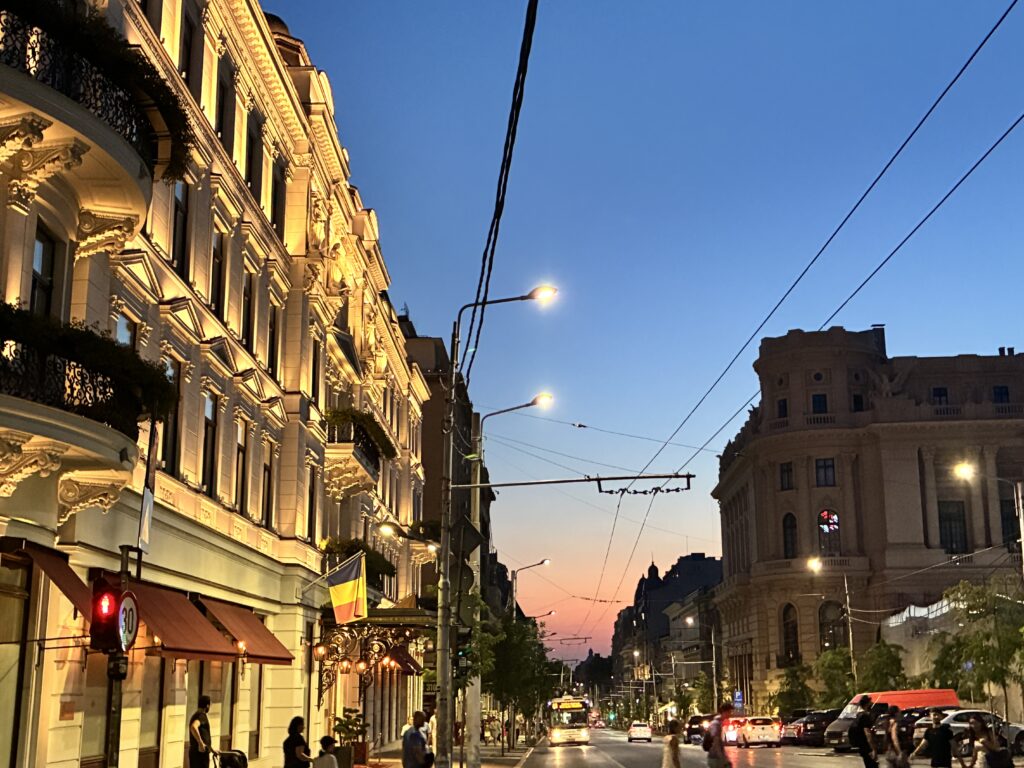
“Summer evenings in Bucharest carry a scent I’ve never found elsewhere,” he’d often tell his friends. “Whether it’s the hot, melting asphalt or my love for this city taking physical form, I can’t say.” The hum of people and cars drowned out his footsteps. He stopped at a terrace for a beer and spotted a place to sit. He was not alone. He asked two girls sitting at a long table if he could sit down as well. One gave a dismissive wave similar to Clara’s, seeming unbothered. Andy settled at the opposite end, careful not to intrude on their conversation. He drank his beer like a cup of tea while someone at another table played guitar. The singer’s whiny voice clashed with both the tune and the combat boots.
The waitress’ voice reminded him that his glass was empty. “Can I get you anything else?” She spoke with warm familiarity. Part of him wanted nothing more than to linger, soaking in the light and the life of the city. He carried with him the ache that hovered just beneath the surface, but now he felt it was time to turn it into something else: a source of strength, even inspiration. A sense of duty made him get up and leave.
He walked back trying to hear his footsteps again. It was quiet enough in his mind that the city filled out every void the way he wanted it to, but the moment he started looking for his keys in front of the door, he realized he’d returned home without the bottle of wine. He let himself in, knowing Clara wouldn’t ask about it. She did not. She never fully understood Andy’s desire to keep certain things private, little secrets she allowed him to have. To him, unanswered questions or vague smiles instead of words were not lies, just a pure absence of information rather than a malicious coverup. “If you don’t provide details about something, you’re lying,” she used to tell him. “Trying to conceal the truth is what makes it a lie.” While he found her logic overly simplistic, he appreciated that she never asked him “where,” “why” or “when.” The truth was she avoided asking because she didn’t want answers she wouldn’t like.
Clara quietly took the bottle of champagne they had saved for their tenth wedding anniversary. There was still a long time until then, Andy thought, and champagne knows how to wait. Clara didn’t.
They walked behind each other, listening to their footsteps on the black marble. At the party, Clara leaned close and whispered, “Don’t disappear on me tonight.” Andy gave her a half-smile. “I need some air.” She shook her head, already scanning the room for faces. “You always do.”
Clara moved through the room, collecting faces and voices, while Andy slipped away to the garden. Bianca’s garden reminded him of a small cemetery. Since he was little, he had always found cemeteries to be some of the most beautiful parks. They held stories. The long walks on sunny winter days among crosses and tombs filled with past life were not at all sinister to him. They reminded him that he was alive.
He took a deep breath, inhaling the thick scent of roses until another smell overpowered it. A few steps away, a woman smoked. Her cold, striking beauty caught his attention.
“I’m sorry,” she said, “You’re out enjoying the fresh air, and I’m poisoning you.”
Andy smiled, “Don’t worry. I’m Andy Carp, an old high school classmate of Bianca’s.”
The girl continued smoking without replying. He accepted the silence somehow; it felt comfortable. The music and voices from the house grew louder as she finally spoke.
“I’m Ana, Bianca’s former colleague.” So this was Ana. Andy had heard stories but couldn’t recall specifics. As he stood there trying to remember, she stubbed out her cigarette and came closer.
“What’s your story?”
“My stories, you mean. Aren’t we all made up of multiple stories?”
“If they are related to Bianca, our common friend, happy to hear them. Let me start. I met her at our first job. We were sitting in these cubicles, staring at each other all the time and making jokes. We had a boss who would come and flex his muscles, talking to our male colleague from the next cubicle about his workout at the gym and then asking us if we liked what we were hearing. Horribly offensive, of course, and we both left that place soon after, but now it became a story.”
“There you go. Well, I write stories for a living. Is that a story in itself?”
“If you don’t want to reveal much about you, yes, it is,” Ana added, shrugging her shoulders. “So what do you do, sit in your room and write all day, and then crash parties to eat and drink at the end of the week?”
“I did not crash it. I was invited.”
“I know, I was kidding. Tell me about your writings then.”
He didn’t quite get her sense of humor, but something in him felt compelled to keep the conversation going. Her eyes were round and dark, and her fingers were so long that every time she spoke and gestured, leaning slightly closer to him, he couldn’t shake the feeling that she might accidentally poke him.
“I write about things people know but may have forgotten. It’s like revisiting the past and examining it through the lens of today. Sometimes, I stumble upon a new place, a physical location, I mean, and become so captivated by it that I can’t stop writing. I love to travel, but my wife doesn’t, which adds its own set of challenges to my writing process. I don’t cover news, yet keep an eye on trends, and I hate when I have to do it for clicks.”
“Still not clear. I hope your writing is more coherent than that. How about you read me the last paragraph of your latest piece, even if it’s unfinished?”
Her tone reminded him of Clara’s, sharp and cutting, as if she was trying to hurt him for no reason. A part of him desperately wanted to leave, but her gaze held him in place with such intensity that he couldn’t find the courage to walk away.
He pulled his phone out and went to his last document. “Any flutter of wings ultimately ends with a dull, heavy thud that foretells the end of the flight. And what follows cannot be called a fall, for the man with the face of a bird and the heart of a wild animal is now on the path of no return, the only road where his strength is no longer of any use.”
The girl nodded. “OK, so fantasy?”
“No, it’s not at all, although it seems like a different world now. I am finishing a story about my high school years. It’s an analysis of those years as a teenager under communism, with the indoctrination leading to more-or-less dangerous creativity and teenage rebellion. But I have been thinking lately as I read more pieces on this topic on the Internet, you know, the story written on a Romanian site in Romanian becomes an opinion piece. The same story shared to a larger audience in English becomes valuable information and it tells our story to people who did not live it, but since history repeats itself, it could be useful to other generations in other countries. Look at the political situation in Western countries and the United States..”
She cut in gently. “You think comfort did that?”
He paused, considering. “Maybe. Having too much makes people careless. We didn’t have the option to choose. We learned what it meant to go without. That kind of lesson doesn’t fade easily. But it’s hard to understand it unless you live it or read extensively about it, and I feel the world needs these stories.”
“I see. Do you think you can write that story in English? I have a friend who might like to look at it and place it.” She handed him a little business card. Andy smiled and put it in his back pocket without looking at it. He had no intention to give it to somebody to “place it.”
But he lied. “I have to add some finishing touches. Language is not a problem.”
When he went back inside, Clara was looking for him, wanting to go home and trying to explain to the host why. “It’s a migraine that hasn’t left me for days, ever since I taught a business class to former military personnel. I failed to engage them; I just did not share enough analogies from their world. They found nothing familiar to grasp onto and preferred silence over questions. It was a professional challenge I didn’t recognize at first, resulting in this endless migraine.”
They walked home with the same odd, measured steps as soldiers changing guard at the palace.
The next morning, the phone rang persistently.
“Andy, it’s Bianca. I have theatre tickets for tonight but can’t go. Are you interested?” Bianca’s voice was so loud that Andy had to hold the phone away from his ear, as if afraid of catching a virus.
“I’m home alone; Clara may be back late. I don’t want to ruin your plans. But if you don’t have anyone to give the tickets to, I’d like to come by myself.”
“Let’s meet right in front of the theatre.”
Andy arrived early, as usual. With so many people out front, he had to stand at the top of the stairs to spot Bianca. He heard the gong, but knew she’d likely be late. He scanned the crowd rushing toward the entrance.
“You’re here!” uttered Andy, puzzled by his own statement as the quiet girl with piercing eyes smiled at him. It was Ana, who’d kept him company in Bianca’s garden.
“I am here! I knew you’d expect me.” Her spontaneous, somehow sarcastic reply as she played along broke the awkwardness. He noticed that smile again almost tattooed on her lips.
“I have the tickets. Bianca apologized, but she forgot she had a work thing. Are you alone?”
Andy smiled without immediately answering, searching for the right words. “My wife will be home late, so I allowed myself this little outing.”
Ana nodded as she reached into his shirt pocket and put his ticket there. A quick 180-degree turn followed, and she headed toward the entrance. Andy remembered that same sudden yet graceful turn from the night before. They entered with steps sharing the same rhythm, like tiny drums with different intensity. His steps were shouting from the top of the stairs. She walked fast without looking back, as if someone followed them.
“Should I ask if you come here often?”
“If it’s not a pickup line, sure. And I actually do,” he answered with a very serious voice. “One of my best friends is an actor, not a very popular actor, but a good actor and also a documentary filmmaker.”
“Oh, documentaries, the non-money makers of the business. But we need more of those.”
“Yes, I thought about making one, but then maybe I should focus more on making money, right?”
“What would the documentary be about, Andy?”
“The ideas are not an issue; the execution is. Well, I am very much preoccupied with how many things have changed in Eastern Europe, yet how people’s mentalities have not. Looking at it from the outside, not the inside, yet with the experience and memories of an insider, if that is even possible.”
“So you have an unfinished high school piece and unfinished thoughts about your documentary. You are a true artist caught up in his daily life. I am still waiting for your piece, don’t forget.”
“You waiting for it is a good reason to finish it.” The line fell flat, and he knew it, sinking into his seat before the stage lights dimmed. They acknowledged each other’s presence with occasional glances during the performance. At intermission, she went outside to smoke. He sat reading the program, looking at the empty stage until he suddenly got up. An incomprehensible feeling of adultery made him avoid the crowded lobby. Blinded by night and by his own thoughts straying beyond his actions, he left before she returned to her seat.
He drifted through the hallways of the theatre with the weight of guilt pressing on him; the guilt for being there felt the same as the guilt for wanting to leave. He lingered by the exit stairs, chain-smoking as the play lasted longer than he had hoped. The universe and the playwright gave him enough time to leave, yet he stayed. Ana showed up as he was smoking his last cigarette.
“That wasn’t very smooth of you. The second part of the play was the best one, too.”
“Oh, I always miss the best parts. Are you thirsty? Would you like to get a drink?”
He said it quickly, somehow caught between wanting to go and hoping she’d refuse. Ana looked him right in his eyes, those dark and distant eyes that gave nothing away . “I’m never thirsty, maybe only for knowledge.”
“That makes two of us,” Andy replied. “Having said that though, I’m more human than most believe, so I actually am thirsty for a drink now.”
“More human than most people believe? That almost convinced me, but I have an early morning meeting. Still interested in your writings though, so send me something.”
Ana hopped from the last step, smoothing her skirt with a playful gesture. In another world, he might have held her hand. In this one, he slipped both hands into his pockets. Clara used to say his hands knew how to tell stories, but she also managed to add that it was a shame more of those stories never made it onto paper. Some did. Some would.
My hands are born at equal intervals of time / Giving birth to each other again and again. / My hands are a pair of butterflies, / Condemned to turn back into caterpillars. / And then, although they will remain mine, / You will no longer want to touch them, / And you will run away from my touch / As if it were death itself.
Clara was home when he quietly opened the door, trying to turn the key silently in the lock.
“I heard you went to see a play. Great idea! You need to get out more.” Her tone dripped with sarcasm. Andy didn’t understand why she’d make such a sarcastic remark, because he was home late or because he went out without her. She looked somehow relaxed, although her eyes were twinkling feverishly.
He sat on the edge of the couch next to her. “Are you feeling alright? I see you’re sitting under two blankets, and it’s hot in here.”
Clara pulled the blankets closer and pushed him with her feet, “I’m tired. I’m going to bed. Good night.” She got up and left, dragging one blanket behind her. The other lay on the couch, an unspoken invitation for Andy to sleep there.
He always understood her subtleties and silent cries, respecting them. He could smell her on the couch cushions, but that neither aroused him nor stirred memories; it simply kept him from sleeping and filled him with anxiety. His eyes opened and closed until night became day. As she got ready to leave in the morning, Andy kept his eyes shut, clinging to the couch, with the blanket over his head. He waited until the door closed and then jumped out of bed. He sat in front of the computer, barely moving until late afternoon; his hands were numb, but an explosive happiness helped him move on. He finished an article about San Francisco.
The article fulfilled a promise to the editor-in-chief of a local lifestyle magazine. Andy had mentioned to him that he had a conversation at a party with someone from San Francisco, which sparked so much research in the following days that he felt like he had actually visited, so he documented everything. He walked the streets, listened to musicians and dropped coins in guitar cases, lounged on Golden Gate Park’s grass, and watched seals at Pier 39. This so-called diary was nearly a documentary of what he thought was an inaccessible world for him, written like Stoker’s Dracula, through research alone. The issue was giving it “the tone that sells.” The requirement was clear. “Polish it up, make us look smarter than the Americans, and throw in some dollar amounts. Rich people, rich buildings – give me something to sell to my audience,” his friend instructed. Andy didn’t know how to polish it that way. He knew how to labor over the perfect word, express feelings, or lend stories light or darkness. But a forced tone would kill that initial spark. When needing money, he wrote neutral articles requiring little editing. But this was his first about an unvisited foreign land; a story set in Romania’s mountains may have been safer. He craved change though; his travel tales grew too familiar, set in the same country, beautiful, but far too traveled by his real steps and imaginary pen.
The challenge wasn’t the location, but finishing the story itself. He had always struggled gathering his thoughts in complete stories. Clara often reminded him of that. To her, every one of his articles was not viewed as a literary achievement, but as his ability to finish something. She needed to view him as accomplished to love him. He thought not of money or fame, but his elusive idea. Sleepless nights spent reading other people’s books and blending their ideas with his thoughts, writing spontaneous novels in his head without reaching paper, while the idea refused to appear despite sending countless messenger ideas.
He often found himself lost in thoughts that no one else could follow, tangled in unfinished sentences and half-formed images. The world outside seemed distant, almost irrelevant, like background noise he barely registered. He was living in his unfinished work. The consequences lingered, subtle but persistent, and he had no solution for them.
He looked over the story once more. It wasn’t the one he wanted to write, but it was the one he had to write, as life always demands a choice between wants and needs. Maybe that was the price of truth: to trade what could have been said for what must be said.
Outside, the morning light pressed gently against the windowpane, indifferent to his struggle. His phone began to ring. Most of the time, he didn’t answer it. From his perspective, that was the answering machine’s duty. But many people didn’t leave voicemails, preferring dialogue over a monologue that unnerved them slightly. Clara used to get mad when she heard people hanging up instead of leaving messages. Andy understood their reaction, though. “A monologue on the phone, like a photograph, fails to capture movement or oratorical verve. It accentuates our verbal flaws the way those awkward smiles stand out in pictures.”
He moved closer to the window and let the phone ring. It was one of his favorite “games.” He’d choose a specific person walking down the street and create an entire story around them. Sometimes he tried including Clara in his game. “I don’t know why we need to talk about others, Andy. Don’t you see how much imagination we need to see our own lives in color?” He’d smile, kissing her while trying to appreciate her pragmatic perspective, the one their relationship needed, he thought. She tried to support him every time he seemed to be too detached from reality. Clara often warned, “Your imaginary world is much stronger than the real one. One day, you won’t be able to separate truth from imagination, and then you’ll become dangerous to yourself.”
He looked at the caller ID and finally answered. “Andy…” Clara’s voice trembled, fragile and sharp at once. He froze with his hand pressed to the phone, feeling the weight of years in a single syllable.
“Good… good thing you’re home,” she added.
He stayed silent, unsure whether she wanted a response or just needed to hear him there.
“I haven’t slept all night, Andy. You probably don’t understand… you can’t descend into the world where we all dare to live.”
Her words stung, but not in the way anger usually did. This was exhaustion, sorrow, and maybe a surrender.
“Listen to me… please, listen this time.” She drew in a shaky breath. “Our relationship… it had all those good pieces, so many very good pieces… but I’m too tired to believe in it anymore. Those pieces keep falling off, and I… I can’t keep holding them in place. I can’t.”
Andy’s hand tightened on the phone. The room felt too quiet, the air thick. He wanted to say something, anything, but her voice pressed ahead, urgent and unrelenting.
“I’d like you to leave, Andy. I’m not chasing you, and I don’t want to be the one leaving. Please… it’s better for both of us. We keep drifting… and I have no strength left to watch it.”
There was a pause, and he imagined her breathing into the phone, waiting for some sign of relief. “Forget each other for now… at least therapeutically. Maybe later you’ll find a few words for us… from all those words you carry around.”
Andy exhaled slowly, letting the words sink. Nothing he could say would stop her words from landing. He hung up without answering. A phone call to end such a long relationship may have felt like an insult to anybody else, but he appreciated it. He felt nothing and had nothing to say, although he wished he could have defended himself. He didn’t know how because he believed in words and didn’t want to scatter them.
“Wasting words is like wasting water in the desert,” he once told Clara.
She smiled in disbelief, “That’s not true. You can produce words whenever you want, words that can hurt, love, or fill the silence.”
Andy used to cover her mouth with his palm, “Shhh! Words aren’t dead. They take the form of our feelings. Just like time, we can’t bring them back. We are our words. Nothing else shows we’re alive.”
She would laugh and push him away, “Our beating hearts and warm bodies kind of do.”
In their case, the real separation happened in silence. So he chose silence in the end. It started years ago, back when he was still sharing his thoughts and she listened with an “uh-huh.” There was no drama, but they both became quiet after a few years. There was no support and no real partnership, only repetition. Without passion and wonder, they stopped wanting. They left a long time ago.
Andy took his old gym duffel, packing just a few changes of clothes. As he left, he made a symbolic gesture, sweeping everything he’d felt and been a part of in that house beneath the doormat. He headed to a hotel where he usually sent out-of-town friends. Once checked in, a flood of happiness washed over him and some kind of an inner peace brought a smile. He spent the day rewriting his article but fell asleep beside his laptop, waking up early in the morning, cold, and hungry. Happiness had turned to anxiety, but he quickly pushed it aside, realizing the pure freedom underneath.
Andy stared at the San Francisco piece, still tormented over the ending. Then, it dawned on him: the imaginary trip didn’t want to end because it was not lived. He opened the window. “Tell me if you want to see a world outside your window…” The boulevard was alive and so were all his happy memories, never told, yet lived and loved. Starting from what he lived and loved could be the stepping stone to what he truly wanted to write. He searched his folder, found the high school story that he had told Ana about, and began typing. The words came easily and for the first time in years, everything felt pure and simple again.